I'm thrilled to announce the first commercial release of Munduk bamboo music.
Yesterday Aneka Records set up a battery of mics in a pavilion at the high-end hotel on the hill midst the 12-piece bamboo gamelan in my previous post. Six hours, a box of wax paper-wrapped rice and meats, and a round of coffee later, there were two raw hours of classical and new pieces taped.
I've uploaded a rehearsal of Pak Terip's newest piece, also mentioned in the previous post, for your previewing (pre-auditioning?) pleasure. Obviously my equipment wasn't up to the acoustics of the space, but it gives an idea of the woody, soulful sound in dramatic pelog scale.
To finance the CD production we're offering the first copies at a sliding scale of $12-20, with free shipping for orders of 10 or more. The jacket will feature full color photos and complete credits. The pieces will be mixed and mastered under I Made Terip's supervision once we reach the $1000 production goal. Comment with questions or make your free-shipping orders directly by Paypal.
During lunch we were all startled by an explosive collision between a jackfruit and the tile roof. I have now witnessed a giant spiky fruit tumbling dangerously from its perch.
Wednesday, February 8, 2012


Saturday, February 4, 2012
How an appraisal took 10.5 hours
Yesterday was one of the rainiest here, moderate to heavy with intermittent downpours. Every time it let up for a minute, Pak Terip called, "Qian! Ayo!" let's go! whereupon it would immediately pour again. He wanted to check out a gamelan that needs tuning in Pelapuan, a village down an assortment of winding and flooded roads.
He was in a strange mood. When I got up he had been at it with Kosil (background) and a couple other artisans making a new set of pelog scale gerantang (click for sound sample):

I asked if they were for himself as opposed to a commission, and he answered in the affirmative. Around midday he was done with the set of 14 keys he was working on, and sat thoughtfully in his pile of bamboo shavings playing phrases softly on the instrument beside him (above center), stopping to gaze in stillness or to take a drag from the cigarette resting on the chopping block. I asked if he was composing, but he didn't answer. When I tried to clean up his work area, he stopped me, protesting that he liked it.
Eventually he had the help string new keys on an old frame, scolding him for doing it too loosely. On the paired instruments he played a piece or two with Kosil before the latter got distracted fussing with a new suling. More solo ruminating on a playful melody that would race were he to play it through.
It was almost two when we finally trekked up to the road in light drizzle and waited some ten minutes for the driver to return to the parked jeep. One of the players, Datoex, from the sanggar followed along; "melali," he answered when I asked why, "just wandering." He was 20, a high school grad and unemployed aside from helping out with instrument making and playing gigs. He shared his cassava and rice cake snacks as the jeep wound its way through the awful weather and roads to an empty warehouse on terraced rice fields.
A woman armed with a giant umbrella greeted us as we waited on a covered raised platform. Eventually she brought coffee. We waited more than an hour before she appeared again, excusing the owner's absence for the rain. Pak Terip roused from his nap, made a phone call, and off we went to sit with 'a friend' in a neighboring house.
The driver, Datoex, and I hunched at one end of the table while Pak Terip chatted with the friend about alcohol, gambling, and some other topics I couldn't discern. Datoex and I joked under our breaths and shoved roasted beans in our nostrils for entertainment. We were two or three hours there before another friend arrived, chatted even more, and then caravanned with us back to the warehouse. It was long after dark.
The gamelan themselves were interesting: a septatonic metal angklung and new gong kebyar, and collection of cengceng, drums, and suling. The elephantine warehouse was the biggest acoustical mistake I've ever been in; I felt drunk or drugged at first, wondering why I saw my teacher damping keys but heard them ringing continuously. Then I couldn't help laughing at how out of tune the reyong was, and Pak Terip took advantage of my evident mirth to sell his services. After the necessary fuss about how much work was necessary, the men involved sat to examine the drums.
Then, the moment I live for: one man placed a bunch of suling before my teacher. He picked them up one by one, improvising circular-breathed phrases one after another. His breath filled the warehouse like sourceless light. Again and again, my breath caught. On a peculiarly flattened note goosebumps flashed like ice splashes up my left arm and side and the right side of my head but left my core body steaming (pardon the somatic minutia). My mind flashed to dreams of busking and playing restaurants and concerts in America.
I understand gigging takes more time than the actual engagement, but if I can help it, an appraisal to tune and fix gamelan in America will not take 10.5 hours.
He was in a strange mood. When I got up he had been at it with Kosil (background) and a couple other artisans making a new set of pelog scale gerantang (click for sound sample):

I asked if they were for himself as opposed to a commission, and he answered in the affirmative. Around midday he was done with the set of 14 keys he was working on, and sat thoughtfully in his pile of bamboo shavings playing phrases softly on the instrument beside him (above center), stopping to gaze in stillness or to take a drag from the cigarette resting on the chopping block. I asked if he was composing, but he didn't answer. When I tried to clean up his work area, he stopped me, protesting that he liked it.
Eventually he had the help string new keys on an old frame, scolding him for doing it too loosely. On the paired instruments he played a piece or two with Kosil before the latter got distracted fussing with a new suling. More solo ruminating on a playful melody that would race were he to play it through.
It was almost two when we finally trekked up to the road in light drizzle and waited some ten minutes for the driver to return to the parked jeep. One of the players, Datoex, from the sanggar followed along; "melali," he answered when I asked why, "just wandering." He was 20, a high school grad and unemployed aside from helping out with instrument making and playing gigs. He shared his cassava and rice cake snacks as the jeep wound its way through the awful weather and roads to an empty warehouse on terraced rice fields.
A woman armed with a giant umbrella greeted us as we waited on a covered raised platform. Eventually she brought coffee. We waited more than an hour before she appeared again, excusing the owner's absence for the rain. Pak Terip roused from his nap, made a phone call, and off we went to sit with 'a friend' in a neighboring house.
The driver, Datoex, and I hunched at one end of the table while Pak Terip chatted with the friend about alcohol, gambling, and some other topics I couldn't discern. Datoex and I joked under our breaths and shoved roasted beans in our nostrils for entertainment. We were two or three hours there before another friend arrived, chatted even more, and then caravanned with us back to the warehouse. It was long after dark.
The gamelan themselves were interesting: a septatonic metal angklung and new gong kebyar, and collection of cengceng, drums, and suling. The elephantine warehouse was the biggest acoustical mistake I've ever been in; I felt drunk or drugged at first, wondering why I saw my teacher damping keys but heard them ringing continuously. Then I couldn't help laughing at how out of tune the reyong was, and Pak Terip took advantage of my evident mirth to sell his services. After the necessary fuss about how much work was necessary, the men involved sat to examine the drums.
Then, the moment I live for: one man placed a bunch of suling before my teacher. He picked them up one by one, improvising circular-breathed phrases one after another. His breath filled the warehouse like sourceless light. Again and again, my breath caught. On a peculiarly flattened note goosebumps flashed like ice splashes up my left arm and side and the right side of my head but left my core body steaming (pardon the somatic minutia). My mind flashed to dreams of busking and playing restaurants and concerts in America.
I understand gigging takes more time than the actual engagement, but if I can help it, an appraisal to tune and fix gamelan in America will not take 10.5 hours.
Sunday, January 22, 2012
No rehearsal, just get it done
At midnight I was pretending to pray along with the small gamelan geguntangan accompanying shadow puppet-like singing at a Tilem ceremony. It was a mixed gathering of locals and Balinese from Jakarta; a dalang, or puppetmaster, took turns with family members to sing from books in Kawi and Balinese. It was neat to see the simplified, unpitched gamelan (keyed gong, cengceng, three metal and bamboo kempli plus kajar and tawatawa) follow kendang (double-headed drum) at intervals and in phrases determined by the texts. The suling (vertical flute) had to follow not only melodies chosen by the singers but in keys that fit their registers; there was much heroic shuffling of instruments and alternate fingering.
The singing was intended to invite taksu, but the magic happened for me when my teacher picked up a suling after the regular player had given up matching one singer's key. Bending over the kendang in his lap, he sent flickering bamboo melody like stones skipping from the singer's notes, quick and true, spontaneously dancing over vocal ripples. There was no rehearsal, no precedent, only the resonant meeting of living fluency and long vocal lines of texts older than memory. Voice and breath; characters sometimes refined, other times monsterous; accompanist at once submissive and flying high between lines; together secure in the carriage of pulsing gamelan.
At a signal from the dalang or the regular flutist, or from the content of the text itself he would drop the flute and rouse the gamelan with lightning-quick drumming. A nod to the gong player for shorter cycles, a subtle glance in his son's direction and the ensemble leaped and cruised as one. I had been sitting with him barely an hour before the start of the ceremony when he got the call inviting him to play; they wanted him there immediately and he protested that he had no ride -- the house was a ways across the village. Similarly last week the village gamelan sprang it on him to drum the sacred Rangda dance just before it was beginning.
So it goes in a town with four fluent drummers: my teacher and his sons. Welcome, year of the dragon.
Friday, January 20, 2012
Field and concert recordings available
If you like reading about my Balinese family, send a donation by clicking the button to the right. $20 gets me internet for a month, any more helps me secure the basic cost of living: $60 monthly food and coffee, a room in the family complex, $10-$20 rides for odd errands into town. I'm feeling the negative replies from schools here. I have a few local projects cooking, but it'll take time to build social networks to support them.
Here's the first of a series of Sanggar Teripittaka recordings available for download with your donation: Kebyar Duduk. I can also mail a CD to you. Donations for recordings all go to the sanggar, not to me. The audio is field quality, but possible to transcribe for teaching purposes. It's from a 6-month temple ceremony at Wanagiri. Outside the temple walls, food and toy vendors lined the alley, making good business of the holiday traffic. Boys flashed their new toy helicopters and cars inside the temple. Periodically a train of priests and helpers would tour the shrines in the outer temple, placing incense, waving mirrored bowls, and throwing holy water.

Sitting with the gong there, I caught myself again imagining a yet-incomprehensible anthropological complex in motion around me, incomprehensible at this point because of cultural and linguistic differences, but perhaps years from now soluable. If I'm unaware of the complex, does it cease to exist? Can I render it insignificant through sheer willpower? And through will, can I create a reality in which I am powerful and untroubled, always immersed in the ecstasy of Rumi?
I recalled, while recording gerantang at an empty hotel restaurant still earlier, Rumi's poem about serving wine. One mustn't taste this wine we serve, he wrote, while still intoxicated from one's previous drink. To enjoy life's present to the utmost, we must wait until we're over the impact of some prior moment. Worry, regret, crankiness spoil the magic of living. To live this way, and still function in producing good work, surviving, and caring for those one loves, has long been my challenge.
On to the year of the dragon. May it be powerful yet just.
Tuesday, January 10, 2012
Mlas-pasan: Induction ceremony for the new instruments & space
Photos from Sunday's ceremony. The sanggar moved in right away, practicing. Check out the video -- that's Kosil, the composer, in the foreground leading on kendang (drum).
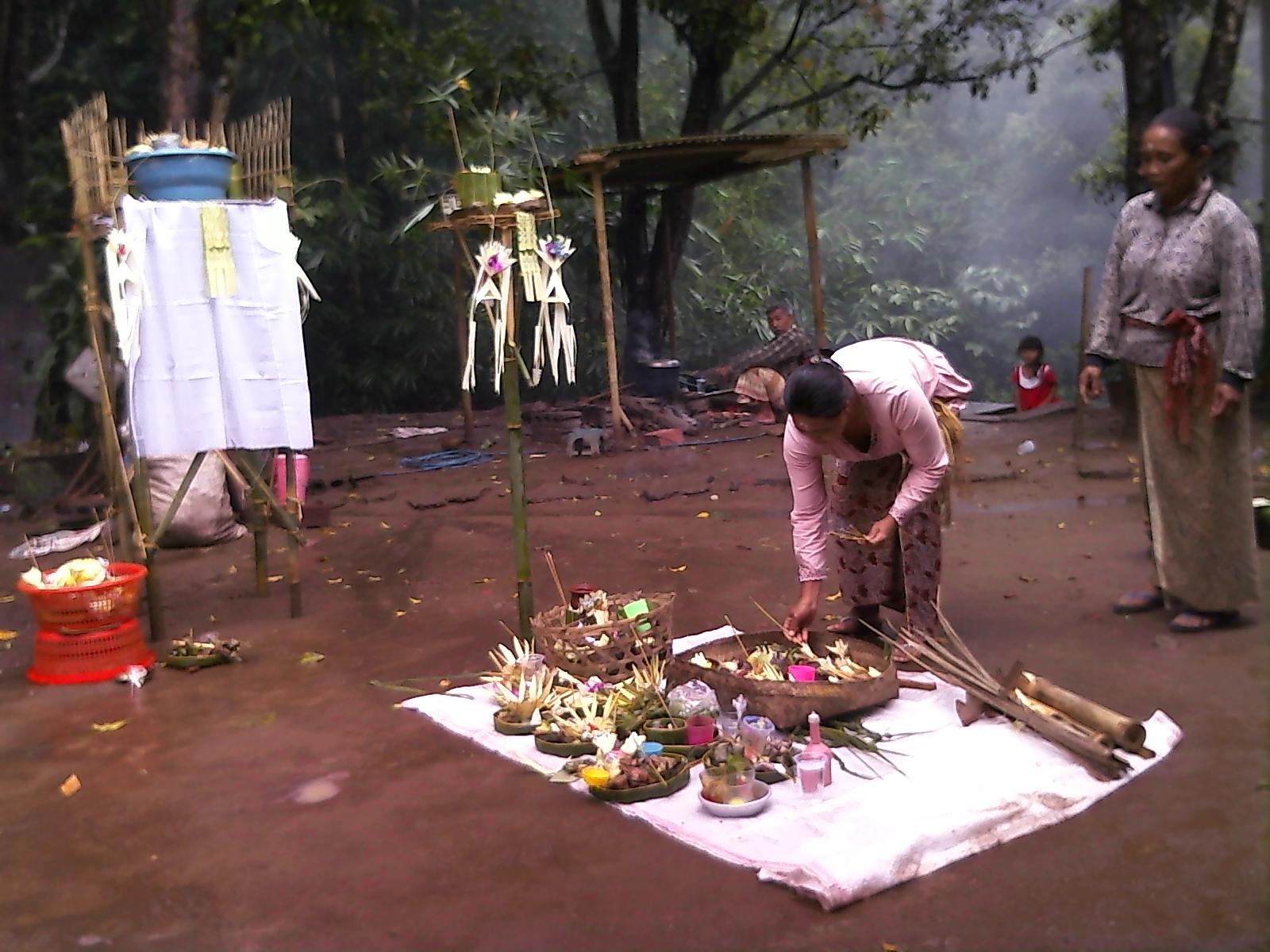
 Several women, all distant relatives, joined forces with Ibu Nengah over several days to make a zillion banten and sajen, sacred offerings crafted from leaves, fruit, and flowers. These alone were for the new gender wayang and gansa keys.

I figured out that men make satay and lawar because they require cooking only at the end, after everything's been peeled, chopped, and mixed. Here they are working outdoors. The kitchen was bustling with women cooking everything else.

The host is expected to feed all the workers. Yum.

The night before, all the instruments arrived from cramped makeshift quarters at Kosil's house up the street.

 Pak Terip's brother Ketut carves little wood parts, I forget for what ceremonial purpose.

The priest's setup for the formal ceremony:

A Balinese cousin, Kadek Andre (left), drums.

Here's a favorite grandson... I guess nephew for me... in red, center right on calung. He reminds me of myself when I was little, eager to read and write. He's already good at gamelan, cocky as the other, older boys.


Offerings have to be placed everywhere -- someone climbed a ladder to hang these on the corners of the roofs. It's assurance that every spot in the new space is cleansed of bad intentions.


The boys in the background arrived ahead of the ceremony and dutifully await their turn to practice.
 Some more close-ups of the banten for the instruments. There's all kinds of holy water in the little glasses for the god Visnu.


 The itty-bitty house, left background, contains shrines. They opened the door for folks to pray during the ceremony. they made a temporary bamboo shrine to invite the sun goddess to rest here, along with a small platform with a sprig of leaves (middle ground) to appease bad spirits. The stack of offerings on the post (left foreground) is a permanent offering place for muses to grace the rehearsal space.

The priest had lots of help from family members while reciting the required mantras. Check out the flowers and leaves he's wrapping around the bell.
 Also around his hat.
 A spread of offerings before the temporary shrines:
 And then a ritual fire with bamboo for the god Brahma:


Members of the sanggar wait patiently during the recitation. I provide some amusement with my webcam photography.


Pak Terip and his son Putu Putrawan, far right, the primary hosts, wait close at hand.

 The concluding prayer during which all Hindu worshippers offer a series of poses and flowers. Pak Terip's youngest son, Ketut, center, and brother Kosil behind him:

 I was too enthralled by this step of the ceremony to take pictures (also wary of flying holy water), but a train of sanggar and family members carried offerings and those symbolic tools in the bottom right corner of the spread above, circumambulating the family complex to cleanse the space spiritually.

And after all that there was more recitation dedicated to the new instruments. And that is where the remainder of your donations went!
Every year the instruments have a little birthday, which require a smaller version of this ceremony. If you liked this post, please share and click the button on the right to contribute.


I figured out that men make satay and lawar because they require cooking only at the end, after everything's been peeled, chopped, and mixed. Here they are working outdoors. The kitchen was bustling with women cooking everything else.

The host is expected to feed all the workers. Yum.

The night before, all the instruments arrived from cramped makeshift quarters at Kosil's house up the street.


The priest's setup for the formal ceremony:

A Balinese cousin, Kadek Andre (left), drums.

Here's a favorite grandson... I guess nephew for me... in red, center right on calung. He reminds me of myself when I was little, eager to read and write. He's already good at gamelan, cocky as the other, older boys.


Offerings have to be placed everywhere -- someone climbed a ladder to hang these on the corners of the roofs. It's assurance that every spot in the new space is cleansed of bad intentions.


The boys in the background arrived ahead of the ceremony and dutifully await their turn to practice.


The priest had lots of help from family members while reciting the required mantras. Check out the flowers and leaves he's wrapping around the bell.


Members of the sanggar wait patiently during the recitation. I provide some amusement with my webcam photography.


Pak Terip and his son Putu Putrawan, far right, the primary hosts, wait close at hand.


And after all that there was more recitation dedicated to the new instruments. And that is where the remainder of your donations went!
Every year the instruments have a little birthday, which require a smaller version of this ceremony. If you liked this post, please share and click the button on the right to contribute.
Thursday, January 5, 2012
Happy birthday to us
You wanted it, we made it happen:

An anonymous donor and Anthony's Hardwood Floors completed the matching challenge.
At the metal worker's, I sat meekly in the van with a daughter-in-law and her kids while Pak Terip and a son negotiated with the pande. If a foreigner shows up, the pande assumes it's for him and jacks up the price. At some point, the beguiling sound of gender wayang sang out to the road and I bent my ear to the crack in the car window (it was pouring). I grinned. It was Terip's prized bold baritone quality. When they arrived in the arms of the son, I peeked and was immediately struck by the smallness of the keys in contrast to the big sound of low pitches I'd heard.
No sooner had he got them home was Pak Terip fussing over which keys would be tuned to get the scale he wanted, and which resonators would have to be tuned or replaced. He was on it first thing the next day, with the help of a couple friends. The unpainted bamboo resonators were replaced because his standard is for the key's width to be just shy of being able to fit inside its resonator. The offensive black paint was not yet dry in places and the diagonal bridges were crudely cut with sharp edges, leading to much cursing.

Here's the money shot, with his youngest son Ketut in the back:

Pak Ketut Arina stopped by to check out the freshly tuned new aquisition. Listen to a selection from their repertoire on my Soundcloud. That's sugar water he's drinking -- it reminds me of the time I asked for water when Ibu Kom offered coffee or tea. She came out with hot water sugared so heavily the stuff couldn't all dissolve and sat in a heap on the bottom. I don't know how Pak Terip has any teeth left -- that's how he has his coffee.

While you're there, listen to this surprising 2-min clip from New Years Eve's performance at Puri Lumbung. It's a cappella and unrehearsed since the sanggar's visit to Hong Kong a couple months back.
Come back next week for photos of the combined ceremony to invite spirits into the new instruments and to spiritually balance the newly built rehearsal space. Pak Terip explained different types of gamelan require different spiritual designation. Gender wayang, used for most wedding, tooth filing, and funerary ceremonies, are more sacred than the competitive gong kebyar and require certain care; similarly, the rehearsal space cannot be used until the appropriate ceremonies have been performed because it's adjacent to sleeping quarters.
A huge thank you from both Bapak and I for the generous donations, and in particular to my family for providing the challenge.
Monday, January 2, 2012
Over 10% there with 2 days to go!
Together with my family's matching gift, Yue Max Li's pledge from Joshua Tree, California, brings our campaign total to $220.
Thanks, Max. Give while the challenge lasts and double your impact.
Subscribe to:
Posts (Atom)